Who Wants to Watch a Robot Figure Skate?
The more technology commoditizes, the more we seek the value of realtime human performance and shared experience.
By Roman Hadley
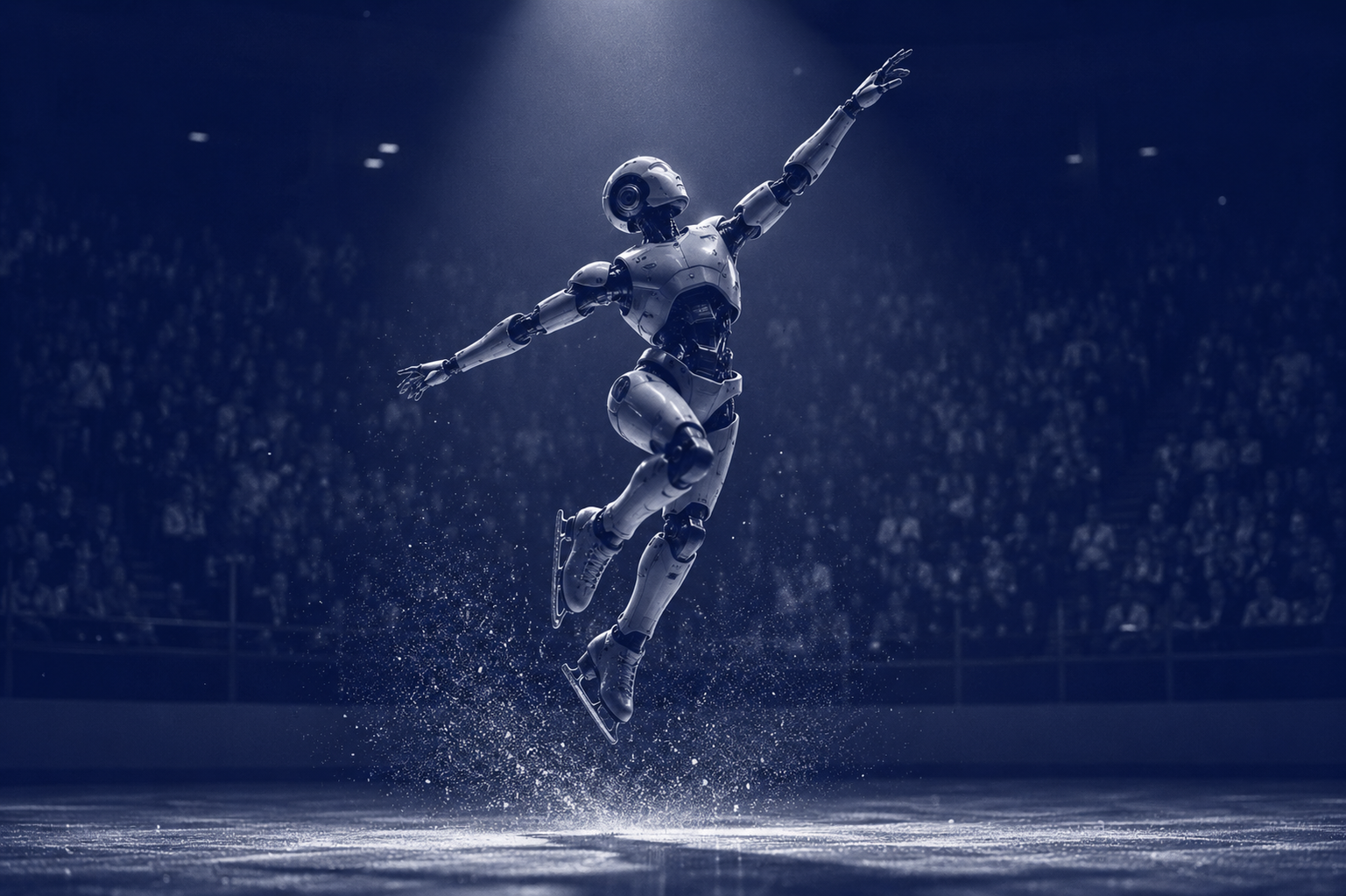
You watch the triple axel land perfectly. Then again, identical. Not even a wobble. The skater’s face, expressionless. Because it doesn't really have a face.
This is not a small distinction. It’s the whole ballgame.
The novelty lasts just long enough for you to dare imagine what the robot could do armed with a broom or a gun.
Then you’re over it.
Because what makes this worth watching isn’t the skating. It’s the skater.
It’s how much led up to the triple axel, and how much that might still not be enough tonight. It's the ten thousand mornings at 5 a.m., the ankle that snapped in practice two years ago and nearly ended the story. It's the still moment before the music starts, the private negotiation with fear. Then the lights come up and the outcome is truly, genuinely unknown.
Remove the backstory, the sacrifice, the possibility of failure, and you're watching a Roomba doing donuts on ice.
We increasingly choose technology over reality. But we also increasingly value what it can’t replace. It’s why shared experience and human performance is more of cultural and economic driver than ever.
Arenas (And Stages) Are Everywhere
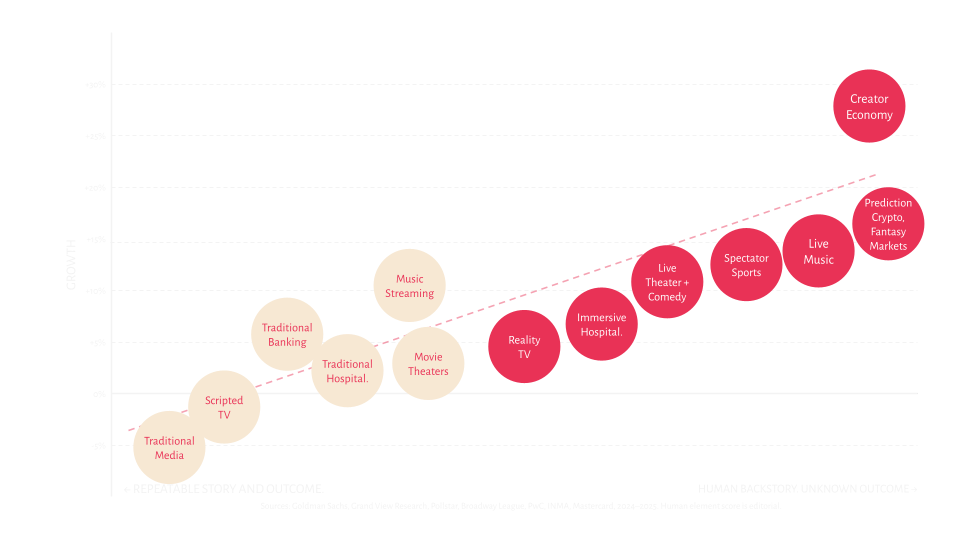
People embrace these fly-or-flop moments, attach themselves to hard-earned craft, skill, stories, and experience. It's part of what's driven a 65% growth in experience spending in recent years. Younger generations prioritize experiences over things even more.
And it's a thread woven into anywhere real humans perform for and with other humans in real time. Because even as things like movie theaters, bowling alleys, and even bars are fewer and far between, spending on “touch-grass” experience is headed up:
Live Music. Live music revenue hit $38 billion in 2025, up 10% year over year. Concert ticket prices have climbed 60% since 2019. You can't stream the moment before the first note, when 20,000 people go quiet. A recording of Kamasi Washington is not the same thing as seeing him improvise live in London.
Reality Television. The genre we've been calling trashy for thirty years now accounts for 25% of all U.S. television ad spend. 57% of 18–34 year olds prefer unscripted content to scripted. We watch because we believe the people on screen can actually embarrass themselves, actually fall in love with the wrong person, actually get sent packing.
Spectator Sports into Niche Sports. A market projected to double to $330 billion by 2033. The demand for the traditional sports has extended to NCAA gymnastics finals, the America's Cup, competitive climbing. Once there’s enough competitor backstory, the sport almost doesn't matter. MrBeast proved this on YouTube: Beast Games is nothing but human contestants and genuine stakes and it drew 50 million viewers in its first month.
Live Theatre and Comedy. Broadway's 2025 season was the highest-grossing in recorded history. The chemistry that wasn't there in rehearsal. The collective held breath in the dark. None of it can be replicated by anything that cannot actually forget, actually recover, actually feel the heat of lights. Live comedy ticket revenue has nearly tripled over the last decade. AI can generate competent jokes. But it can’t be a person in a room, trying to make strangers laugh, exposed and without a net. It cannot bomb or spar with hecklers. Big reasons we go.
Immersive Hospitality. 62% of diners want chef's tables, themed dining, culinary workshops. The open kitchen is not a design choice. It's a promise: a real person is making your food right now and you can watch them care about it. The chef who spent twenty years perfecting her craft is not competing with low-margin AI-driven delivery apps. She's offering devotion made visible.
The Creator Economy. A bedroom, a car, or a kitchen at midnight offer the purest stage for the whole idea. The global creator economy will hit $500 billion by 2027. What's being sold is access to a specific person, unscripted, in real time, over time. The creators thriving on TikTok, Twitch, podcasting, live-streaming are the ones who are unmistakably human. They post unabashedly, make mistakes on camera, change their minds, have a history. Those sharing honest failures score 44% higher in credibility than positive-only posters. Failure is a win.
That Other Thing. As an example of just how unlikely a place this can turn up, look at how its even crept into financial services. Prediction markets, fantasy gaming, and crypto are all rich in the kind of quirk and drama we used to think no one wanted near their money. Now they’re growing faster than traditional banking.
Novelty Vs. Narrative
The figure skater will not be replaced because all along we have not been watching the skating. We have been watching the skater. Eating the food, but appreciating the cook. Laughing at the jokes but watching the joker jest without a net.
That investment compounds. The longer a career, the richer the narrative, the more we care about what happens next. LeBron in his twenty-second season matters differently than LeBron at nineteen because the story got longer and the stakes grew. Algorithms only accumulate data.
The fact that nobody wants to watch a robot figure skate says something permanent about us that is turning up in our culture more than ever.
We want to see what people are made of when it counts. We want the story, the stakes, the chance of failure, and the moment when someone either rises to it or doesn't.
You’ll watch the robot for a moment’s novelty. But a person for a lifetime’s narrative.
Mark that safe from the robot takeover.