
What If You Journal But Absolutely Never Call It Journaling?

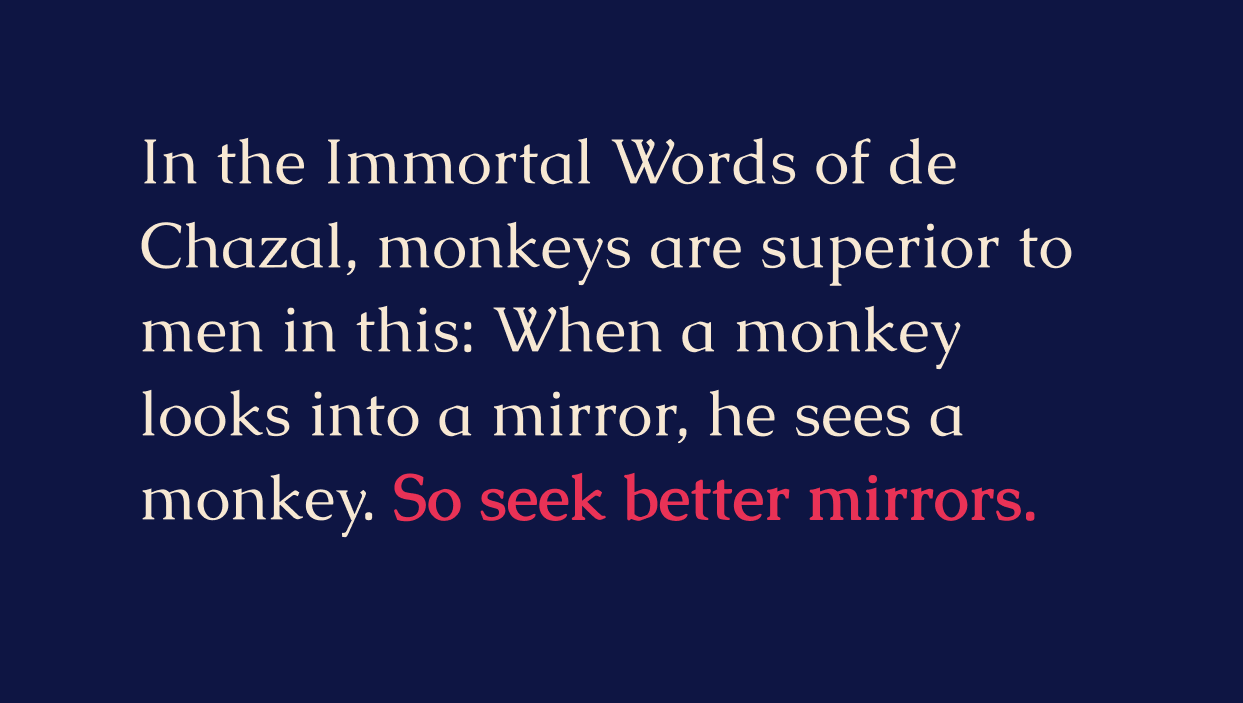
Throughout your life, you will have the nagging feeling that your best thoughts are fugitive monkeys that rocket past as you’re nodding off. Vanished!
Your worst thoughts, meanwhile, pull over and stomp on your forehead through sleepless nights.
Either way, life has much to do with regulating your mind and its monkeys.
One way to do that is to scribble furiously. Regularly.
This ritual now has a brand name: journaling.
I did it for so long that back when I started people just called it “writing shit down.” Then I stopped. Now I think everyone should start.
____________________
Journaling can be the difference between thinking and knowing what you think.
Maybe to you journaling’s always seemed like a practice reserved for creative types, therapy enthusiasts, people who light way too many candles. And if your instinct is to outsource your thinking to something faster and more articulate than you (read: AI), you may be outsourcing your highest and best future value.
Because the point of this isn’t output. It’s to connect to your own mind.
It turns out nobody else’s shovel digs you the way you dig you.
The process is the whole point. If it makes you feel better, 10 minutes of solid journaling is probably good for at least 3 truly unique-to-you AI prompts.
As with most things, the people who’d benefit most probably don’t do it. People running companies (from solo to 100,000) and making decisions under pressure, managing impossible amounts of incoming noise, are the ones that often need a way to get out of their own heads, and a way to see what’s in there. Before you ever try to figure out what’s in the heads of, say, customers, employees, you name it.
____________________
But somewhere along the way, writing things down became an industry with a kind of culture to it. Retreats, graphical artifacts, prescribed rituals, a hundred thousand products on Amazon. Journal-scented candles (I just made that up…but it’s a good idea). Very navel-gazey. All of which creates a sort of tribal reason why the people who’d benefit most from it want nothing to do with it.*
But it doesn’t dilute the core value that was always inherent in the unfiltered confrontation with your own thoughts.
Not performance. Not publishing. Not building a personal brand out of your evening reflections (maybe that’s later). Just the act of getting what’s inside your head (practical, emotional, inspirational…whatever) outside of it where you can see it and wrestle with it.
____________________
So don’t feel obligated to join the new age journal tribe unless that’s your vibe. I am convinced writing things down (in prose, lists, doodles—whatever) has no value unless it’s at least a small act of rebellious creation, and as little as possible an act of reactive consumption. It’s got to change the world, or someone’s (possibly your own) idea of it. At least a smidge.
Writing it down is step one. Interacting with what you wrote is step two. That’s where it gets real — the shift from monologue to dialogue, from generating to pattern recognition. The compounding value isn’t in the writing itself. It’s in reading it back and discovering what you actually think.
It either crosses a bridge or it starves on its own island.
____________________
For years I wrote without ever reviewing. Pages and pages, retired to closets. I was generating without interacting — a verbal hoarder. The lesson wasn’t that the practice was useless. It was that writing without reading what you wrote is like taking notes you never study. The act feels productive. The compounding never happens.
Eventually you will have to reveal something of yourself to write something that matters, even to yourself. Just pick your time and spots. It’s not about being famous or building a legacy. It’s that audience is energy — even when you’re the only audience, as long as you’re a discerning one.
So here are my rules to journal by for someone who isn’t sure they should be journaling at all:
Do it. Often.
The value is in the act, not the outcome. No one asked for this. It’s yours.Ignore Most Voices.
Even this one. Do what you feel you must. There are whole industries telling you what to do. Don’t.State the Most True Things.
This the best advice for any writer’s block. And it will help you as much for self-examination as for a new product idea. Do not be polished or defensible. Be true.Read What You Write.
Interact with it at least half as much as you generate it. Patterns you don’t see now, you’ll see later.Use a Medium That Travels.
Across time. Across devices. People are selling you objects, but that may not suit your objective.Share Selectively.
Not everything. Pieces. Enough to pressure test. For yourself. For the ones who care. For whoever. You’ll know.Drop the Titles.
You’re not a journal(i)er or a writer or anything else. You don’t need a badge for this or anything else in life.Talk About It Less Than You Do It.
This rule works for almost everything.Edit Your Approach Ruthlessly.
Consistency’s good. But reinvent, renew, revisit how, when, why if you sense a rut.Don’t Label It. Okay, call it whatever you want—just make sure it feels like it’s yours and not that verb
they made up 10 years ago. Just go.
Apart from two of us, none of us have ever been Shakespeare or Steve Jobs. When we die, our entire literal and figurative library burns up and scatters to the stars. A few random fragments install in a loved one’s memory, or into some small legacy of art or commerce.
All the journaling in the world won’t prevent all your memories, thoughts, and ideas from going up in smoke.
The idea is to get in there and make them burn first.
____________________
*PostScript: My Journey With Journaling
I used notebooks. The “what’s-the-point-if-no-one-sees-it” kind. With the feel and scent of that modest, anachronistic material made by pulping quiet trees for anonymous people.
I’d harvest ideas from iPhone Notes, napkins, texts I’d sent myself. I’d write until a stopping point sentence as lofty as the grade-grubbing capper of a high school English essay. After 365 pages, the books retired to closets to marshal dust.
The ratio of garbage to gold within will never be known; we can be sure most of it is worthy of the landfill.
For the final two of those years, I peaked with a massive one-page-per-day Lett’s diary purchased from Blackwell’s Bookshop in Edinburgh, Scotland. A nerd’s spell book bound for a Dungeons & Dragons convention.
“I knew I was journaling; I just never meant to be journaling.” —Me
Somewhere in my journey with journaling (a twofer of modern ick words) journaling became a thing. An industry. An entire economy.
While journaling, you may be thinking less about emptying the contents of your mind and more about, well, journaling.
“Hey, much journaling afoot! Is this exactly how Tim Ferriss does it? Is Uni-ball the pro move in terms of pen? I should probably book an immersive Sante Fe RETREAT!”
The LAST PLACE you want to be trapped with babbling monkeys is an echo chamber.
All of us troglodytes sitting on stacks of handwritten kindling should apparently have been pushing it all live online for profit! Living out loud! A personal brand! Affiliate revenue sharing! In this way, something personally fulfilling gets sucked into an algorithmic vortex of triangulated interests. Sellin’ eyeballs!
I landed on the opposite extreme. As my body of blather grew, so did the realization that no one was ever going to read any of it—including me.
I may as well have written it all with lemon juice.
I’d started with the simple goal of seizing the better thoughts of a day and stopped because it wasn’t helping me live forever. I was a verbal hoarder.
This never bothered me—until it did.
It certainly need not dissuade you from any practice of writing, sketching, listing, ideating, or whatever you may do.
I say line your closet in foam and egg cartons and go in there to record your nightly primal screams if it works for you.
But if your intention is to get OUT of your head and get a bird’s-eye view of what’s in there—whether it’s the taste of a recipe, a novel, a product idea, an insight, or some feels—it has to go. Somewhere.
If a thought falls in the forest, does it make a sound? Yes, but sooner or later one last tree whispers, “why bother?” and they all clam up for good.