How to Stop Playing Brand Elevator Music in An Industry Echo Chamber
Brands speak a language of words, symbols, design, and ideas that become a sort of background music of every industry. If you’re not careful, you can blend right in and disappear.
Brands are social animals. Connected to the circles they, and their stewards, run in.
They speak a language of words, symbols, design, and ideas that become a sort of ignorable background music of every industry. If you’re not careful, you can blend right in and disappear.
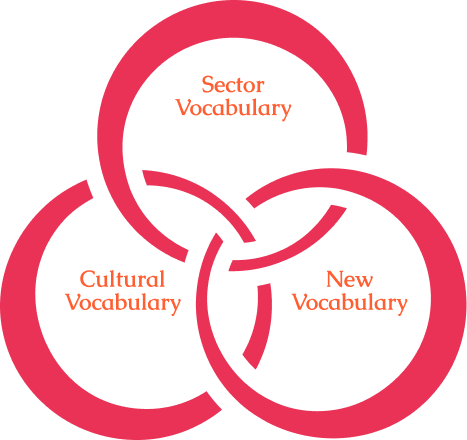
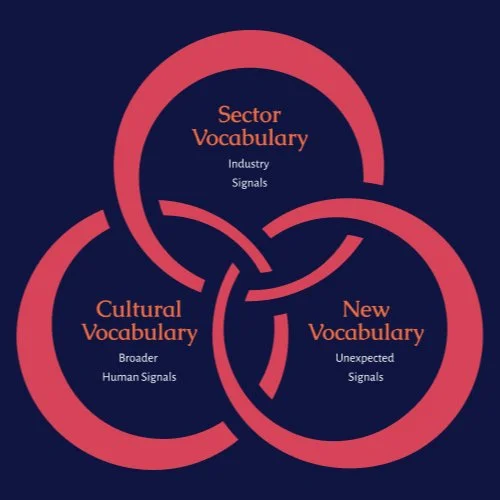
It’s made up of 1) Sector Vocabulary (the signals that mark belonging in an industry), 2) Cultural Vocabulary (signals that land with humans in your broader world, not just your category), and 3) (hopefully) some New Vocabulary (genuinely unexpected usage that earns attention).
Spend too much time in any sphere, and all you’re doing is fluently affirming the bubble you live in. The trick is to find familiar visual and verbal toeholds but offer them in ways that stand out and invite in.
Most brands lean on the familiar because it doesn’t stand out, feel new, seem odd. You know, the ingredients for garnering attention, differentiating. Branding.
Sameness is increasingly the default position when you can feed all the established cues of your sphere into an AI averaging machine and return the same elevator music every time.
____________________
B2B: The Bullshit Bingo World
B2B brands live deep in circle one, rarely wander into circle two, and treat circle three like a hazmat zone. It’s the stuff of parody. The mistake B2B brands make is thinking people make even more rational choices at their work than at home.
Enterprise software: "Empowering digital transformation at scale." Dark navy, clean sans-serif, geometric icons. Not bad branding, just invisible. Confirmation that you exist, and still IBM.
Financial services: "Your trusted partner in financial growth." Stock photo of diverse team shaking hands for reasons. Glass architecture. Fintech shows up and takes your lunch money.
Healthtech: "Connecting care. Advancing outcomes." Bluish-green. A committee who agreed to agree to care a lot. Everyone knows healthcare sucks, but let’s go along get along.
____________________
Consumer Brands: The Commodity Circus
Dwell in circle 2 and you suffer the opposite affliction: chasing universal appeal so hard you sand off all meaning. Fresh. Real. Better. Natural. These concepts can elicit a powerful response if they are conveyed meaningfully. Sometimes they’re just empty words slapped on, rubbed smooth, and crushed in supermarket aisles or paid media A/B tests.
____________________
Circle 3: Novelty As Noise
Circle 3 can feel oddly reactionary. Brands so in love with novelty (or themselves) they forget to make sense. Invented words. Abstracted metaphors. Missions that sound omni-dimensional.
WeWork was going "to elevate the world's consciousness." Not a description of a co-working space. A spiritual movement layered over a real estate business with shaky fundamentals. When the business model buckled, the brand language didn't just look hollow. It looked like a con.
____________________
Hear It Again for the First Time
You want to be that song that comes on the radio that feels exhilaratingly new but connected to what you always wanted.
Every brand modulates these channels like an equalizer to find that balance. Crank one channel too far and people tune out. You become elevator music, or noise, or that weird album your friend keeps insisting is a masterpiece. Get the blend right and you're the song people discover and immediately send to five people.
The brands worth studying are the ones who got the blend right:
Oatly took a commoditized product and introduced the register of a sarcastic friend. "It's like milk, but made for humans." Unexpected voice, universal appeal, earned category authority.
Stripe launched into a category defined by compliance-speak and reassurance theater with a single sentence: "Payments infrastructure for the internet." No adjectives. No promises. Just a confident statement of exactly what they are to actual buyers (developers) who felt seen, not pandered to.
Dollar Shave Club: "Our blades are f***ing great." The razor category was drowning in fake science and delta-force precision engineering claims. DSC dropped all of it and talked like a person. It earned attention with the first word and closed the loop with the last.
____________________
5 Questions to Break Out of Your Bubble
The first step is to be aware of your bubble.
From there, it takes real human intervention to see the greater intersection you could live in and ask pointed questions to get there:
What would this be like if it came from a completely different industry? What if this fintech brand communicated like a record label? Try a bunch of crossfires. Why not?
What one true thing about your product or industry are you pretending isn't true? The thing everyone knows and no one says. Say it.
What human emotion is actually present in the moment your product gets used? Not the aspirational one, the real one? Relief? Mild dread? Quiet satisfaction? Speak to it.
What would a twelve-year-old think was weird about how your industry talks? A twelve-year-old has not yet been socialized. Their instincts are good. They will rip you to shreds.
Can you be more blunt, short, visceral? A useful rule: Anglo-Saxon words and symbols carry universal weight and movement. Build. Cut. Trust. Own. Long Latinate words bog down in insider usage. The simpler the root, the more likely it lives in all three circles.
The goal is to find the right mix: a foothold in what's known, a foothold in what's felt, and something new enough that makes people stop in their tracks. And really listen this time.