
The Return of the
IRL Guerrilla Marketer
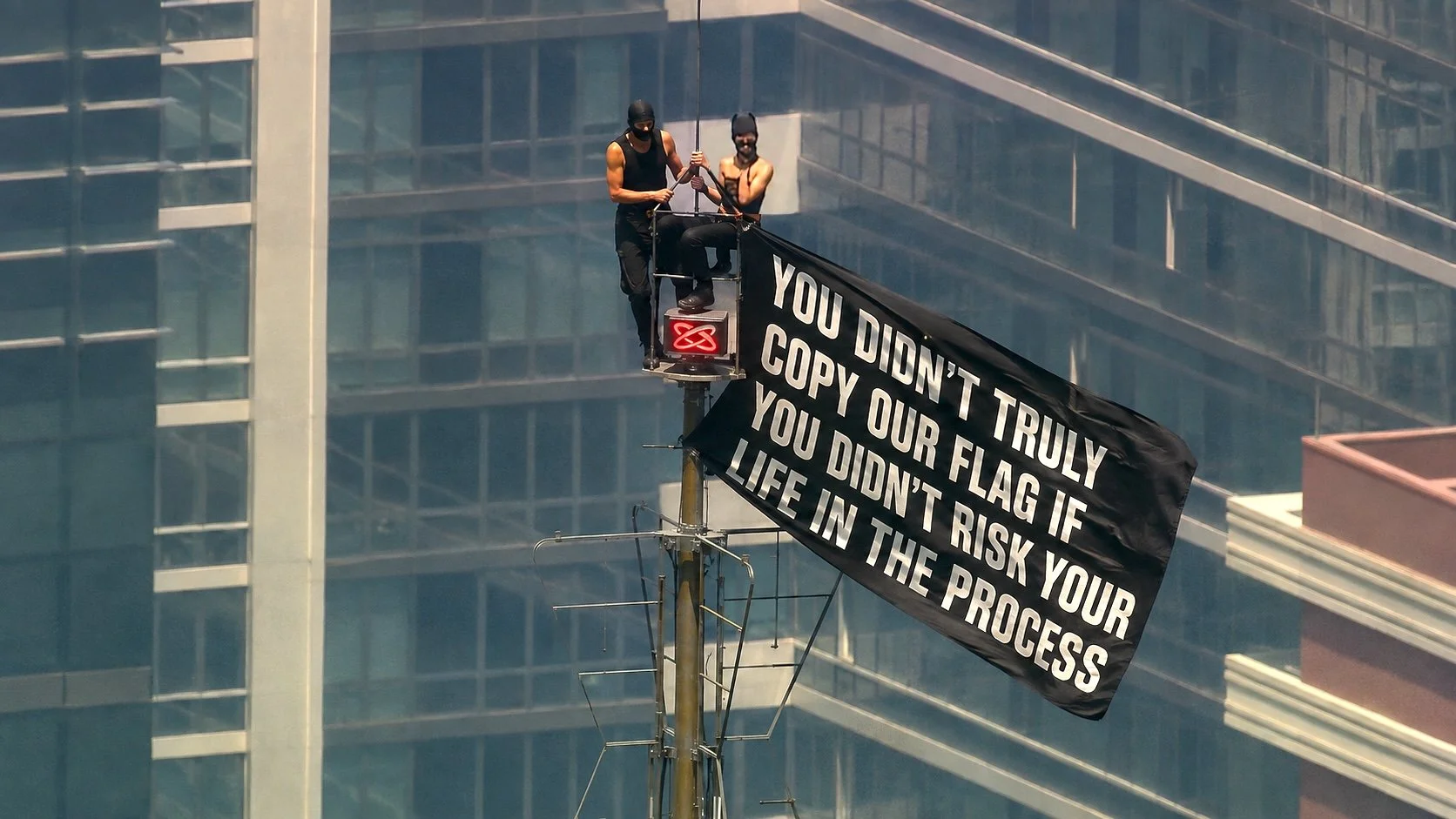
AI can create any content. But it can’t match a well-placed real-world hairball, billboard, or sky flag.
Things could get weird.
You can prompt AI to generate a giant hairball bouncing through Manhattan. Or your own backyard.
Tell AI to tuck a furnished house into a billboard over Sunset Blvd. Or any street on earth.
Plant a flag with any quote you like atop the Empire State Building. Or Mount Everest.
The world is yours. It's just not the real world.
And the real world is still the one people emotionally connect with.
It’s where the above events actually occurred recently.
See, the guerrillas may never have left. But if they did, they sure are returning, bearing hairballs, billboards, and sky flags.
The IRL Rebel Uprising
More and more, we want reminders that people do remarkable things IRL that give us live-source content. We hunt for it, verify it, share it.
Then the internet creates thousands of AI permutations that make us unable to stand the sight of it (see: the flag example).
Half of Americans now say they'd rather give their business to companies that don’t use generative AI in their content at all.
Sure, you can’t always tell. But the bar is not AI detection, it’s trying to create something that screams REAL enough to win hearts and minds.
There have always been marketing stunts that border on performance art. IKEA had someone live inside a store for a week. Harrods had in-store elephants 100+ years ago.
But IRL has a new level of face value. Even when 99% of the audience only ever sees the video on their phone, they know someone stood there by proxy. It happened. It was made by humans.
Attention now sits behind a toll booth just a few platforms control. Meta’s CPM is up 20% in 2026 (higher in many categories). Google CPMs now run $90 to $260+. When it costs so much to pay to reach people, you can see the guerrilla allure of going around the toll booth with unpaid ideas that people capture, argue about, and share.
It’s no surprise these recent examples have rebellious themes:
The March: the giant “Tumblehair” (conceived by Uncommon Creative Studio), tumbling through Manhattan and parking outside Sephora, promoting a hair-loss solution. The revealing thing about this example was the glee with which people shared confirmation that this enormous hairball was, in fact, real. The story itself was whether it was AI or not.
The Occupation: Netflix (and Extra Credit) building a furnished house inside a billboard above Sunset to promote The Last House. An actor inside communicated with the street below using a whiteboard. Just a guy in a box, waving at strangers. A show to promote a show.
The Trespass: A daredevil couple scaled the Empire State Building, got engaged, and planted a banner promoting the idea “when the power of love beats the love of power the world knows peace.” Their altitude was their leverage, so it was funny to watch their flag get endlessly, insufferably memed by copycats who were demonstrably risking nothing.
Brace Yourself for the Wave
Sorting the real from the synthetic, the voidcast from the live source, is a basic skill. AI will be part of many things, and you mostly won’t notice or care.
That’s the point. You won’t care.
These examples reaffirm that you’ll always reserve your most emotional attention and engagement for when you can connect to a real life, real risk, real intention. When it’s a story with a pulse, you will care and you will share.
Nothing lives forever if it never lives at all.
So brace for waves of IRL uprisings. Some that will resonate and inspire.
Some that may be desperate, bizarre, even disturbing bids to punch through the AI voidcast.
And who knows what other interventions they may drop into cities and timelines overnight with no permit and no apology.