
Every Comment Deserves an "Are You Sure" Moment
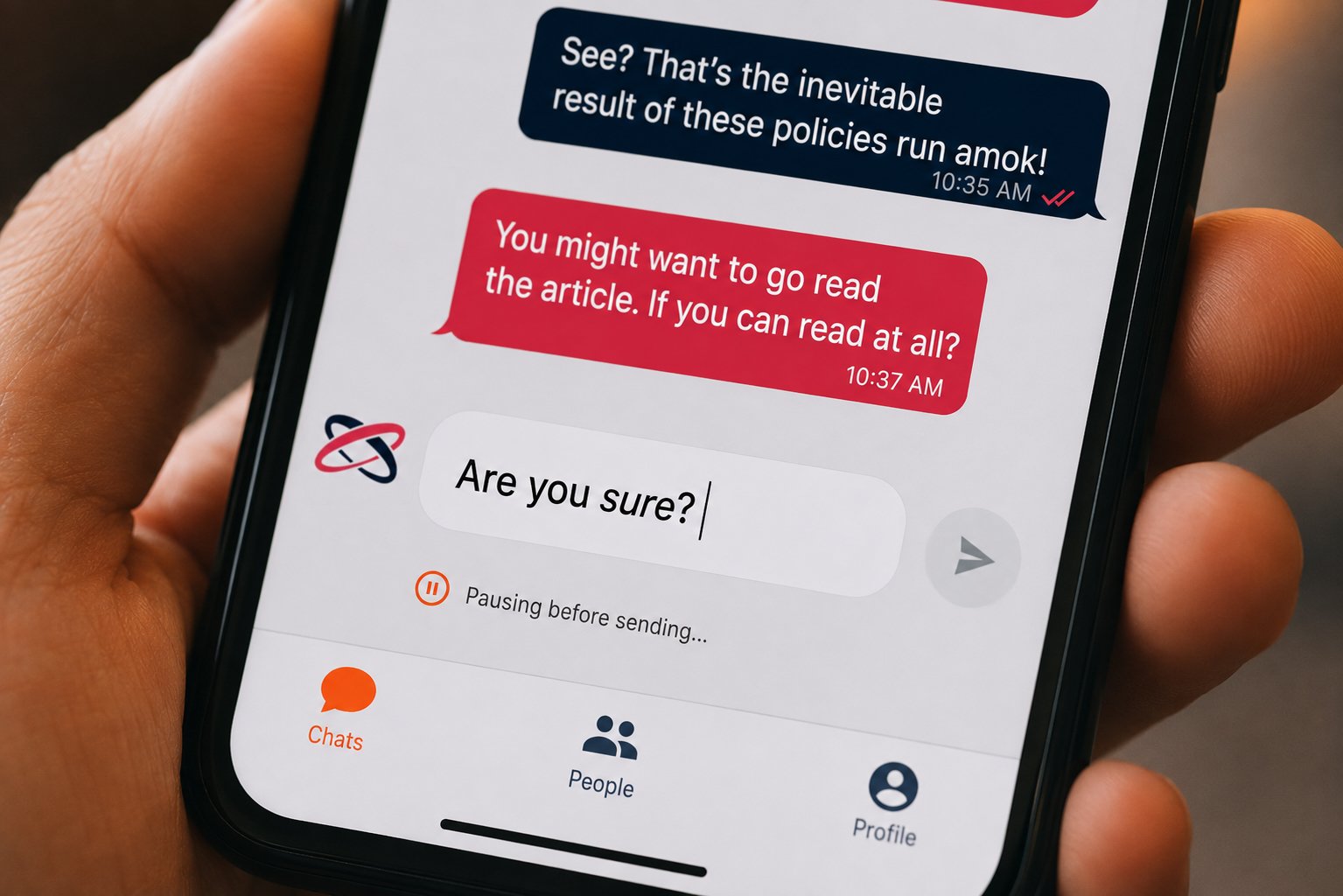
Forget spell-checking. Hell, forget fact-checking. The hard part of online discourse is to just do a moment of intention-checking.
In 2013, thirteen-year-old Trisha Prabhu read about a girl who died by suicide after being harassed on social media.
It inspired her to code an app called ReThink that asks one question before someone sends a potentially hurtful message: Are you sure? That’s it. All it does is inject the chance to think for a second.
Tests showed that when teens paused before sending a nasty message, 93 percent rethink’d it.
It worked like a comment "cooling off" period.
And it’s a question that has superpowers for people on both sides of any comment thread.
We Are Accidental Authors
Comment threads are becoming among the largest body of published writing humans have ever produced.
I's one of those areas where humans have not evolved as fast as our technology.
We didn’t get much opportunity to publish anything when we had barriers like daylight, literacy, paper, a printing press, a publisher, an editor, ways to reach an audience. It's a wonder anyone managed a shopping list or a birthday card.
Now everyone can post. And feel that urge to wade into deep digital debates.
If you've ever dared offer up more than effectively a thumbs up, you may have asked yourself, why the hell would I, or anyone, ever do this? What is achieved by the scathing rebuttal, thoughtful reply, sick burn, or useful add-on?
“Are you sure” you want to participate at all? It's a great question and it’s okay to answer no.
And yet, we fire away. Platforms don't release comprehensive figures, but they surely generate hundreds of billions of comments a year, amounting to trillions of words of public conversation.
It's common to read only the headline of a post and the comments beneath it, and call that engaged. One study found that 75% were shared without the link ever being opened.
The Conversation Became the Content
For better and worse, comments are often not the afterthought so much as the main event.
A scientist publishes new research, and comments become the public peer review. A company launches a product, and comments become the real customer testimonials (a fact brands still haven’t grasped). A restaurant announces its closing, and seventy-eight replies later strangers are debating economics, immigration, and whether civilization is in decline.
A post is a prompt. What it often reveals now is that audiences trust the crowd response as much or more than the institution doing the publishing. They trust personal brands more than brands. On growing platforms like TikTok, comment and original footage stitch together, across video and text alike, so you can't even tell where the thread started.
What it also reveals it that people have had little opportunity to opine in public before, and most have never really thought about the impact of that as creators or consumers. Institutions have never had to show up as people before, and most don't know how to approach that, either.
So here we are, colliding in a medium where often neither seems to know what they're doing.
An organization that used to speak from a podium has to hop into the auditorium. And the people who were sitting quietly in the audience are supposed to hop on stage and wing it whether or not they've developed the tools and standards to take the spotlight.
Contribution Or Reaction?
What is the standard? What are the tools?
Larry McEnerney, YouTube-famous director of the University of Chicago's Writing Program, argues that the purpose of writing is to change how someone views the world.
In other words, if you are going to either make or pay attention to a comment, it should probably make a contribution.
Of the four kinds of "comments," three of them are not contributions so much as just another form of reaction:
Release: letting a feeling rip, with the other person in the impact zone
Performance: playing to spectators who already agree with you, at the expense of one you’re replying to
Confirmation: agreement dressed as commentary, a "like" spelled out in sentence form
Contribution: genuine curiosity and attempts to shift or expand how we see the world, in ways big or small
Discerning between these is a skill worth having when platforms are built to monetize our susceptibility to the reaction vortex.
Trouble starts with a lack of self-awareness about what’s driving a comment. It's a driver you can recognize in yourself, and in others. It can become the guardrails for how to interact as a person or an organization. Cultivate vehement disinterest in negative release, and performative argument. Welcome curiosity and contribution.
It's worth a second of “are you sure?” honesty about whether you’re reading or writing a reaction wearing a comment's clothes.
A comment will rarely change anything, and almost never if it isn't undertaken with that intent. Direct confrontation produces defensiveness, not reflection. The thoughtful contribution produces a quieter evolution: "I hadn't thought about it that way."
Minds change not through victory, but through possibility.
Self-Editing is Self-Awareness
“Are you sure?” isn't about writing or even fact-checking. It's about intention-checking.
That is what happens when you entertain the idea that there's a next step between initially feeling and conceiving something and releasing it upon the world. This step has always been far more important than the first one. It's where you confront your motivations and biases. Then begin the many edits and revisions that are required of any decent content.
The Vocal Minority
There's long been a research rule-of-thumb of 90-9-1: roughly ninety percent of people mostly observe, nine percent contribute occasionally, one percent produce most of what gets written.
On some platforms, public comments have actually been declining and shifting to private channels (texts, DMs, group chats) rather than in public replies. A new form of commenting, video stitching, is on the rise, with the same attendant issues and an even more knee-jerk response time.
In short, the loudest voices you're seeing don't represent the majority. They represent the majority of what gets voiced. It's an important perspective as both a consumer and creator of comments.
Three Magic Words
None of this is an argument against digital discourse, or overly-belabored comments. Humor, spontaneity, and authenticity matter.
This is an argument for a minimum standard: a thoughtful pause. An intention check. And the idea of making a contribution, and expecting others to do the same.
The old system of barriers excluded too many voices. But it required no shortage of "are you sure" questions before anything saw the light: Is it true? Is it useful? Will it change anything? Most of all, why does the world need it?
Let the next thing you read, write, record, or think have a pause long enough for these three words.
Are you sure?